
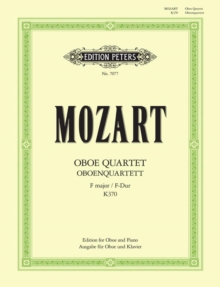
Description
| Product ID: | 9790577080680 |
| Product Form: | Sheet music |
| Country of Manufacture: | GB |
| Title: | Oboe Quartet in F K370 (368b) (Arranged for Oboe and Piano) |
| Authors: | Author: Peter Hodgson |
| Subjects: | Art music, orchestral and formal music, Western "classical" music, Wind instruments |
| Description: | Select Guide Rating The Oboe Quartet in F major, K. 370/368b, was written by Wolfgang Amadeus Mozart in early 1781. The quartet, originally arranged for oboe, violin, viola and cello is presented in this edition for Oboe with Piano accompaniment. In 1780, Mozart was invited to Munich to visit Elector Karl Theodor, who had commissioned the opera Idomeneo for a carnival celebration. While in Munich, Mozart renewed an acquaintance with Friedrich Ramm, avirtuoso oboist in the Munich orchestra. It was for Ramm that Mozart composed the quartet in order to show off his virtuosity and the improvements that had been made to the oboe at that time. One way that this piece showed off the instrument was the use of the 'high F' above the staff, a note rarely played in any repertoire previously written for the oboe. This piece is a work of chamber music, but it has elements that harken to other musicalgenres, and requires a fair amount of virtuosity. Because of its large amount of virtuosic playing on the part of the oboe and the large degree to which the strings simply accompany the oboist, it almost resembles a concerto, butwith only with four players instead of an entire orchestra. Despite this, there are also a number of places within the work that require ensemble playing, for example, the famous 13-bar passage in the finale in which the oboeplays in common time against a 6/8 accompaniment. Oboenquartett F-Dur KV 370 (368b) (Bearbeitung für Oboe und Klavier) Das Oboenquartett F-Dur KV 370/368b wurde Anfang 1781 von Wolfgang Amadeus Mozart geschrieben. Das ursprünglich für Oboe, Violine, Bratsche und Cello arrangierte Quartett wird in dieser Ausgabe für Oboe mit Klavierbegleitung präsentiert. Im Jahr 1780 wurde Mozart nach München eingeladen, um Kurfürst Karl Theodor zu besuchen, der für eine Karnevalsfeier die Oper Idomeneo in Auftrag gegeben hatte. Während seines Aufenthalts in München erneuerte Mozart die Bekanntschaft mit Friedrich Ramm, dem avirtuosen Oboisten im Münchner Orchester. Für Ramm komponierte Mozart das Quartett, um seine Virtuosität und die Verbesserungen zu demonstrieren, die zu dieser Zeit an der Oboe vorgenommen worden waren. Eine Möglichkeit, das Instrument in diesem Stück zur Geltung zu bringen, war die Verwendung des „hohen F“ über dem Stab, eine Note, die in keinem zuvor für Oboe geschriebenen Repertoire selten gespielt wurde. Bei diesem Stück handelt es sich um ein kammermusikalisches Werk, das jedoch Elemente aufweist, die an andere Musikrichtungen erinnern, und ein gewisses Maß an Virtuosität erfordert. Aufgrund des großen virtuosen Spiels der Oboe und der weitgehenden bloßen Begleitung der Oboisten durch die Streicher ähnelt es fast einem Konzert, allerdings mit nur vier Spielern statt einem ganzen Orchester. Dennoch gibt es auch eine Reihe von Stellen im Werk, die ein Ensemblespiel erfordern, beispielsweise die berühmte 13-taktige Passage im Finale, in der die Oboe im Gleichtakt mit einer 6/8-Begleitung spielt. The Oboe Quartet in F major, K. 370/368b, was written by Wolfgang Amadeus Mozart in early 1781. The quartet, originally arranged for oboe, violin, viola and cello is presented in this edition for Oboe with Piano accompaniment. In 1780, Mozart was invited to Munich to visit Elector Karl Theodor, who had commissioned the opera Idomeneo for a carnival celebration. While in Munich, Mozart renewed an acquaintance with Friedrich Ramm, avirtuoso oboist in the Munich orchestra. It was for Ramm that Mozart composed the quartet in order to show off his virtuosity and the improvements that had been made to the oboe at that time. One way that this piece showed off the instrument was the use of the ''high F'' above the staff, a note rarely played in any repertoire previously written for the oboe. This piece is a work of chamber music, but it has elements that harken to other musicalgenres, and requires a fair amount of virtuosity. Because of its large amount of virtuosic playing on the part of the oboe and the large degree to which the strings simply accompany the oboist, it almost resembles a concerto, butwith only with four players instead of an entire orchestra. Despite this, there are also a number of places within the work that require ensemble playing, for example, the famous 13-bar passage in the finale in which the oboeplays in common time against a 6/8 accompaniment. Oboenquartett F-Dur KV 370 (368b) (Bearbeitung für Oboe und Klavier) Das Oboenquartett F-Dur KV 370/368b wurde Anfang 1781 von Wolfgang Amadeus Mozart geschrieben. Das ursprünglich für Oboe, Violine, Bratsche und Cello arrangierte Quartett wird in dieser Ausgabe für Oboe mit Klavierbegleitung präsentiert. Im Jahr 1780 wurde Mozart nach München eingeladen, um Kurfürst Karl Theodor zu besuchen, der für eine Karnevalsfeier die Oper Idomeneo in Auftrag gegeben hatte. Während seines Aufenthalts in München erneuerte Mozart die Bekanntschaft mit Friedrich Ramm, dem avirtuosen Oboisten im Münchner Orchester. Für Ramm komponierte Mozart das Quartett, um seine Virtuosität und die Verbesserungen zu demonstrieren, die zu dieser Zeit an der Oboe vorgenommen worden waren. Eine Möglichkeit, das Instrument in diesem Stück zur Geltung zu bringen, war die Verwendung des „hohen F“ über dem Stab, eine Note, die in keinem zuvor für Oboe geschriebenen Repertoire selten gespielt wurde. Bei diesem Stück handelt es sich um ein kammermusikalisches Werk, das jedoch Elemente aufweist, die an andere Musikrichtungen erinnern, und ein gewisses Maß an Virtuosität erfordert. Aufgrund des großen virtuosen Spiels der Oboe und der weitgehenden bloßen Begleitung der Oboisten durch die Streicher ähnelt es fast einem Konzert, allerdings mit nur vier Spielern statt einem ganzen Orchester. Dennoch gibt es auch eine Reihe von Stellen im Werk, die ein Ensemblespiel erfordern, beispielsweise die berühmte 13-taktige Passage im Finale, in der die Oboe im Gleichtakt mit einer 6/8-Begleitung spielt. |
| Imprint Name: | Edition Peters |
| Publisher Name: | Edition Peters |
| Country of Publication: | GB |
| Publishing Date: | 2001-04-12 |