
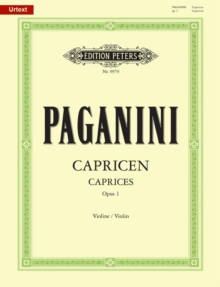
Description
| Product ID: | 9790014079246 |
| Product Form: | Sheet music |
| Country of Manufacture: | GB |
| Title: | 24 Caprices Op. 1 for Violin |
| Authors: | Author: Klaus Hertel |
| Subjects: | Art music, orchestral and formal music, Western "classical" music, String instruments |
| Description: | Select Guide Rating Goethe wrote that after experiencing a Paganini concert he had, "heard something meteoric, and was unable to understand it". It was not until late in his career that Paganini became widely known outside his native Italy. He made his first tour in 1828, and returned to Italy for good in 1834. But the impression he made during these years was to have a profound effect, not only on the course of violin technique but on how virtuosity in general could be incorporated into serious composition - his influence can be felt in music from Liszt and Schumann through Brahms to Rachmaninov (to name but a few of those who have used themes from these Caprices directly) and beyond. The 24 Caprices were probably composed around 1805 - and probably not for public performance. They provide a compendium of Paganini's technique, including extraordinary velocity, a variety of bowing style (balzato, spiccato, martellato etc.), passages in thirds, sixths, octaves and tenths, multiple stopping (up to quadruple), double trilling, left handed pizzicato and the imitation of other instruments (flute, guitar, and horn). No violinist should be without this Urtext edition of one of the most important works for the instrument. 24 Capricen op. 1 für Violine Die 24 Capricen wurden vermutlich um 1805 komponiert – und wohl nicht für die öffentliche Aufführung. Sie bieten ein Kompendium von Paganinis Technik, einschließlich außergewöhnlicher Geschwindigkeit, einer Vielzahl von Bogenstilen (Balzato, Spiccato, Martellato usw.), Passagen in Terzen, Sexten, Oktaven und Zehnteln, mehrfachen Anschlägen (bis zu vierfachen), Doppeltrillern und Linkshändern Pizzicato und die Nachahmung anderer Instrumente (Flöte, Gitarre und Horn). Diese Urtextausgabe eines der bedeutendsten Werke für dieses Instrument sollte bei keinem Geiger fehlen. Goethe wrote that after experiencing a Paganini concert he had, "heard something meteoric, and was unable to understand it". It was not until late in his career that Paganini became widely known outside his native Italy. He made his first tour in 1828, and returned to Italy for good in 1834. But the impression he made during these years was to have a profound effect, not only on the course of violin technique but on how virtuosity in general could be incorporated into serious composition - his influence can be felt in music from Liszt and Schumann through Brahms to Rachmaninov (to name but a few of those who have used themes from these Caprices directly) and beyond. The 24 Caprices were probably composed around 1805 - and probably not for public performance. They provide a compendium of Paganini''s technique, including extraordinary velocity, a variety of bowing style (balzato, spiccato, martellato etc.), passages in thirds, sixths, octaves and tenths, multiple stopping (up to quadruple), double trilling, left handed pizzicato and the imitation of other instruments (flute, guitar, and horn). No violinist should be without this Urtext edition of one of the most important works for the instrument. 24 Capricen op. 1 für Violine Die 24 Capricen wurden vermutlich um 1805 komponiert – und wohl nicht für die öffentliche Aufführung. Sie bieten ein Kompendium von Paganinis Technik, einschließlich außergewöhnlicher Geschwindigkeit, einer Vielzahl von Bogenstilen (Balzato, Spiccato, Martellato usw.), Passagen in Terzen, Sexten, Oktaven und Zehnteln, mehrfachen Anschlägen (bis zu vierfachen), Doppeltrillern und Linkshändern Pizzicato und die Nachahmung anderer Instrumente (Flöte, Gitarre und Horn). Diese Urtextausgabe eines der bedeutendsten Werke für dieses Instrument sollte bei keinem Geiger fehlen. |
| Imprint Name: | Edition Peters |
| Publisher Name: | Edition Peters |
| Country of Publication: | GB |
| Publishing Date: | 2001-04-12 |