
Description
| Product ID: | 9790014043889 |
| Product Form: | Sheet music |
| Country of Manufacture: | GB |
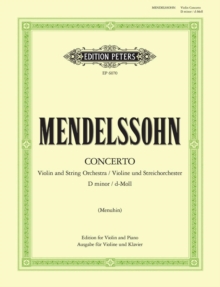
| Title: | Violin Concerto in D minor MWV O3 (Edition for Violin and Piano) |
| Authors: | Author: Yehudi Menuhin |
| Subjects: | Art music, orchestral and formal music, Western "classical" music, String instruments |
| Description: | Select Guide Rating Long before his E minor concerto from 1845, Felix Mendelssohn wrote his first violin concerto: as a 13-year-old in his parents' home in Berlin. There were two sources from which the young Felix drew for this work from 1822: the art of his admired violin teacher Eduard Rietz and the music of Johann Sebastian Bach. Mendelssohn's early preference for concertos and concert pieces in the key of D minor came from the latter's D minor piano concerto, which he played with great enthusiasm. He wrote three D minor concertos alone between 1820 and 1823, and another - his 2nd piano concerto - in 1837. In all of these works, but especially in the early D minor violin concerto with string orchestra, the “Sturm und Drang” of Bach's D -minor concerto, his motor skills and toccata-like passages leave their mark. Mendelssohn's early work is also a memorial to the Berlin violinist Eduard Rietz, who died in 1832 at the age of 29. The Rode student was the young Felix's violin teacher and friend, as well as the founder of the Berlin Philharmonic Society and, as concertmaster, the driving force behind the so-called “Sunday music” in the Mendelssohn house. For this Sunday concert series, half of Berlin made a pilgrimage to the banking family's garden house at Leipziger Straße 3 - exactly where the German Federal Council meets today. They didn't move in until 1825, but Rietz probably also played his student Felix's violin concerto there. It survives in two versions: an early two-movement version and the final three-movement version that appears in this edition by Yehudi Menuhin. The first movement with Bach's rhythms is followed by a lyrical Andante full of Mendelssohn's sound magic and a Rondo in Gavotte rhythm in which Rietz was able to shine in the style of Spohr and Rode Violinkonzert d-moll MWV O3 (Ausgabe für Violine und Klavier) Lange vor seinem e-Moll-Konzert aus dem Jahre 1845 hat Felix Mendelssohn sein erstes Violinkonzert geschrieben: als 13-jähriger im Berliner Elternhaus. Es waren zwei Quellen, aus denen der junge Felix bei diesem Werk von 1822 schöpfte: die Kunst seines bewunderten Geigenlehrers Eduard Rietz und die Musik Johann Sebastian Bachs. Von des letzteren d-Moll-Klavierkonzert, das er mit großer Begeisterung spielte, rührte Mendelssohns frühe Vorliebe für Konzerte und Konzertstücke in der Tonart d-Moll her. Allein drei d-Moll-Konzerte schrieb er zwischen 1820 und 1823, ein weiteres – sein 2. Klavierkonzert – 1837. In all diesen Werken, besonders aber im frühen d-Moll-Violinkonzert mit Streichorchester haben der „Sturm und Drang“ von Bachs d-Moll-Konzert, seine Motorik und toccatenhaften Passagen Spuren hinterlassen. Mendelssohns Frühwerk ist zudem ein Denkmal für den Berliner Geiger Eduard Rietz, der bereits 1832 im Alter von 29 Jahren verstarb. Der Rodeschüler war des jungen Felix Geigenlehrer und Freund, daneben Begründer der Berliner Philharmonischen Gesellschaft und als Konzertmeister treibende Kraft der sogenannten „Sonntagsmusiken“ im Hause Mendelssohn. Zu dieser sonntäglichen Konzertreihe pilgerte halb Berlin ins Gartenhaus der Bankiersfamilie auf der Leipziger Straße 3 – exakt dorthin, wo heute der Deutsche Bundesrat tagt. Erst 1825 zog man ein, doch dürfte Rietz auch dort das Violinkonzert seines Schülers Felix gespielt haben. Es ist in zwei Versionen erhalten: einer zweisätzigen Frühfassung und der endgültigen dreisätzigen, die in dieser Ausgabe von Yehudi Menuhin erscheint. Auf den Kopfsatz mit Bachschen Rhythmen folgen ein lyrisches Andante voll Mendelssohnschen Klangzaubers und ein Rondo im Gavotterhythmus, in dem Rietz im Stil eines Spohr und Rode brillieren durfte. Long before his E minor concerto from 1845, Felix Mendelssohn wrote his first violin concerto: as a 13-year-old in his parents'' home in Berlin. There were two sources from which the young Felix drew for this work from 1822: the art of his admired violin teacher Eduard Rietz and the music of Johann Sebastian Bach. Mendelssohn''s early preference for concertos and concert pieces in the key of D minor came from the latter''s D minor piano concerto, which he played with great enthusiasm. He wrote three D minor concertos alone between 1820 and 1823, and another - his 2nd piano concerto - in 1837. In all of these works, but especially in the early D minor violin concerto with string orchestra, the “Sturm und Drang” of Bach''s D -minor concerto, his motor skills and toccata-like passages leave their mark. Mendelssohn''s early work is also a memorial to the Berlin violinist Eduard Rietz, who died in 1832 at the age of 29. The Rode student was the young Felix''s violin teacher and friend, as well as the founder of the Berlin Philharmonic Society and, as concertmaster, the driving force behind the so-called “Sunday music” in the Mendelssohn house. For this Sunday concert series, half of Berlin made a pilgrimage to the banking family''s garden house at Leipziger Straße 3 - exactly where the German Federal Council meets today. They didn''t move in until 1825, but Rietz probably also played his student Felix''s violin concerto there. It survives in two versions: an early two-movement version and the final three-movement version that appears in this edition by Yehudi Menuhin. The first movement with Bach''s rhythms is followed by a lyrical Andante full of Mendelssohn''s sound magic and a Rondo in Gavotte rhythm in which Rietz was able to shine in the style of Spohr and Rode Violinkonzert d-moll MWV O3 (Ausgabe für Violine und Klavier) Lange vor seinem e-Moll-Konzert aus dem Jahre 1845 hat Felix Mendelssohn sein erstes Violinkonzert geschrieben: als 13-jähriger im Berliner Elternhaus. Es waren zwei Quellen, aus denen der junge Felix bei diesem Werk von 1822 schöpfte: die Kunst seines bewunderten Geigenlehrers Eduard Rietz und die Musik Johann Sebastian Bachs. Von des letzteren d-Moll-Klavierkonzert, das er mit großer Begeisterung spielte, rührte Mendelssohns frühe Vorliebe für Konzerte und Konzertstücke in der Tonart d-Moll her. Allein drei d-Moll-Konzerte schrieb er zwischen 1820 und 1823, ein weiteres – sein 2. Klavierkonzert – 1837. In all diesen Werken, besonders aber im frühen d-Moll-Violinkonzert mit Streichorchester haben der „Sturm und Drang“ von Bachs d-Moll-Konzert, seine Motorik und toccatenhaften Passagen Spuren hinterlassen. Mendelssohns Frühwerk ist zudem ein Denkmal für den Berliner Geiger Eduard Rietz, der bereits 1832 im Alter von 29 Jahren verstarb. Der Rodeschüler war des jungen Felix Geigenlehrer und Freund, daneben Begründer der Berliner Philharmonischen Gesellschaft und als Konzertmeister treibende Kraft der sogenannten „Sonntagsmusiken“ im Hause Mendelssohn. Zu dieser sonntäglichen Konzertreihe pilgerte halb Berlin ins Gartenhaus der Bankiersfamilie auf der Leipziger Straße 3 – exakt dorthin, wo heute der Deutsche Bundesrat tagt. Erst 1825 zog man ein, doch dürfte Rietz auch dort das Violinkonzert seines Schülers Felix gespielt haben. Es ist in zwei Versionen erhalten: einer zweisätzigen Frühfassung und der endgültigen dreisätzigen, die in dieser Ausgabe von Yehudi Menuhin erscheint. Auf den Kopfsatz mit Bachschen Rhythmen folgen ein lyrisches Andante voll Mendelssohnschen Klangzaubers und ein Rondo im Gavotterhythmus, in dem Rietz im Stil eines Spohr und Rode brillieren durfte. |
| Imprint Name: | Edition Peters |
| Publisher Name: | Edition Peters |
| Country of Publication: | GB |
| Publishing Date: | 2001-04-12 |