
Description
| Product ID: | 9789633867433 |
| Product Form: | Hardback |
| Country of Manufacture: | GB |
| Series: | Memory, Heritage and Public History in Central and Eastern Europe |
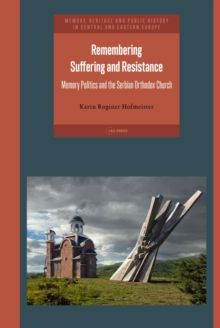
| Title: | Remembering Suffering and Resistance |
| Subtitle: | Memory Politics and the Serbian Orthodox Church |
| Authors: | Author: Karin Roginer Hofmeister |
| Page Count: | 282 |
| Subjects: | History: specific events and topics, History: specific events & topics, Orthodox and Oriental Orthodox Churches, Christianity, Society and culture: general, Orthodox & Oriental Churches, Christian institutions & organizations, Society & culture: general |
| Description: | Assessing issues related to the Orthodox Church from an academic, secular point of view is a sensitive matter. However, by tracing and interpreting the engagement of the Serbian Church with the memory of Serbian heroic victimhood in World War II through a kind of “methodological agnosticism,” this volume has managed to tackle the subtle topic in a very delicate and value-neutral way. Arguing that the search for a collective memory is particularly urgent in the face of societal uncertainty and that religious institutions often use their memory potential to reaffirm their public relevance, the book examines the motivations, forms, strategies, and outcomes of a wide range of mnemonic activities the Serbian Orthodox Church engaged in following the upheavals caused by the collapse of Yugoslav socialism, the violent dissolution of the country, and the fall of the Miloševic regime. These activities, taking place within the memory fields framed by the post-socialist, post-conflict, and post-secular horizons, took liturgical and non-liturgical forms, often involving a hybrid fusion of the two. As a result of this mnemonic endeavor, the author argues, the Church was successful in reasserting its power and legitimacy in the public sphere of post-2000 Serbia. Assessing issues related to the Orthodox Church from an academic, secular point of view is a sensitive matter. However, by tracing and interpreting the engagement of the Serbian Church with the memory of Serbian heroic victimhood in World War II through a kind of “methodological agnosticism,” this volume has managed to tackle the subtle topic in a very delicate and value-neutral way. Arguing that the search for a collective memory is particularly urgent in the face of societal uncertainty and that religious institutions often use their memory potential to reaffirm their public relevance, the book examines the motivations, forms, strategies, and outcomes of a wide range of mnemonic activities the Serbian Orthodox Church engaged in following the upheavals caused by the collapse of Yugoslav socialism, the violent dissolution of the country, and the fall of the Milošević regime. These activities, taking place within the memory fields framed by the post-socialist, post-conflict, and post-secular horizons, took liturgical and non-liturgical forms, often involving a hybrid fusion of the two. As a result of this mnemonic endeavor, the author argues, the Church was successful in reasserting its power and legitimacy in the public sphere of post-2000 Serbia. |
| Imprint Name: | Central European University Press |
| Publisher Name: | Central European University Press |
| Country of Publication: | GB |
| Publishing Date: | 2024-06-30 |