
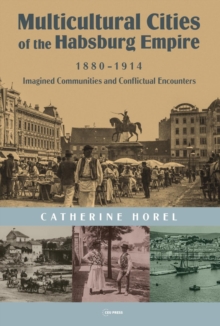
Description
| Product ID: | 9789633862896 |
| Product Form: | Hardback |
| Country of Manufacture: | HU |
| Title: | Multicultural Cities of the Habsburg Empire, 1880-1914 |
| Subtitle: | Imagined Communities and Conflictual Encounters |
| Authors: | Author: Catherine Horel |
| Page Count: | 460 |
| Subjects: | Social and cultural history, Social & cultural history, Urban communities, Urban communities, Central Europe |
| Description: | Select Guide Rating This book offers a comparative analysis of the societal, ethnic, and cultural diversity of twelve cities in the last decades of the Habsburg Monarchy. The following cities are discussed (by their current names): Arad, Bratislava, Brno, Chernivtsi, Lviv, Oradea, Rijeka, Sarajevo, Subotica, Timioara, Trieste, and Zagreb. This selection aims to counter the disproportionate attention that the largest cities in the empire receive. By focusing on everyday life--associations, schools, economy, and municipal politics--the book escapes from the idealization of the monarchy as a paradise of peaceful multiculturalism as well as from the exaggeration of the conflicts. The author claims that the world of the Habsburg cities was a dynamic space where many models coexisted and created vitality, emulation, and conflict. Modernization brought about the dissolution of old structures but also mobility, the progress of education, the explosion of associative life, and a constantly growing cultural offering. Catherine Horel has undertaken a comparative analysis of the societal, ethnic, and cultural diversity in the last decades of the Habsburg Monarchy as represented in twelve cities: Arad, Bratislava, Brno, Chernivtsi, Lviv, Oradea, Rijeka, Sarajevo, Subotica, Timișoara, Trieste, and Zagreb. By purposely selecting these cities, the author aims to counter the disproportionate attention that the largest cities in the empire receive. With a focus on the aspects of everyday life faced by the city inhabitants (associations, schools, economy, and municipal politics) the book avoids any idealization of the monarchy as a paradise of peaceful multiculturalism, and also avoids exaggerating conflicts. The author claims that the world of the Habsburg cities was a dynamic space where many models coexisted and created vitality, emulation, and conflict. Modernization brought about the dissolution of old structures, but also mobility, the progress of education, the explosion of associative life, and constantly growing cultural offerings. |
| Imprint Name: | Central European University Press |
| Publisher Name: | Central European University Press |
| Country of Publication: | GB |
| Publishing Date: | 2020-11-10 |