
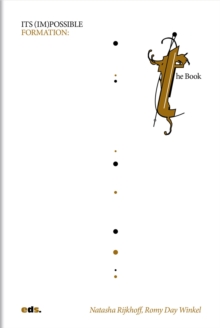
Description
| Product ID: | 9789083362120 |
| Product Form: | Paperback / softback |
| Country of Manufacture: | GB |
| Title: | Its (Im)possible Formation |
| Authors: | Author: Natasha Rijkhoff, Romy Day Winkel |
| Subjects: | Design, Industrial and commercial arts, illustration, Industrial / commercial art & design |
| Description: | Select Guide Rating If you walk into the book shop, through the large open gallery space and past the kitchen, through the unsettling mirrored door frame, into the Riso-workshop, past the ink- drums, drying racks and narrow wooden staircase, you will see two doors. On them is written ‘staff only’. Go through those doors and there is the warehouse of Onomatopee; high and full, with racks and racks full of books.This publication started with a warehouse full of books, which turned into an exhibition, and then turned back into printed matter.Anything can be an archive. Its definition is mutable and open for interpretation and hard to define, as it is used in various ways depending on context. One definition is: a collection of documents created or gathered by one person or institution and selected for long-term preservation as evidence of their activities.We extended an open invitation to artists, writers, publishers, graphic designers and poets to write about these themes from their own perspective and expertise. The contributions range from A Warburgian Constellation by Leonie Harkes to the gossipy poetics of unpublished/unpublishable photobook reviews by S*an D. Henry-Smith.There are compact essays on the design, form and feeling of three of Onomatopee’s publications by Formal Settings, the authors of Notes on Book Design (2023), as well as Ambient Reading, A Method by Sal Randolph. Mia You has contributed A List of Prepositions as Propositions, to which Romy Day Winkel has responded by applying an erasure poetry writing method to fifty silk bookmarks.Natasha Rijkhoff contributed notes on Unstable archiving and Jesse Muller writes about archives and drawings in her text ''Sometimes I ask my brother to make me a drawing.'' The publication has been designed and put together by Tjobo Kho.As we navigate through the pages of this publication, it becomes evident that the book and the archive are no rigid entities with clear boundaries; they are malleable objects and concepts, shaped by interpretation and their social and material context. They emerge as living organisms, adapting to the changing currents of the people moving alongside them: a testament to both curatorship and chance, design and chaos. This publication celebrates this unruliness that comes with amassing and assembling a publishing practice. If you walk into the book shop, through the large open gallery space and past the kitchen, through the unsettling mirrored door frame, into the Riso-workshop, past the ink- drums, drying racks and narrow wooden staircase, you will see two doors. On them is written 'staff only'. Go through those doors and there is the warehouse of Onomatopee; high and full, with racks and racks full of books. This publication started with a warehouse full of books, which turned into an exhibition, and then turned back into printed matter. Anything can be an archive. Its definition is mutable and open for interpretation and hard to define, as it is used in various ways depending on context. One definition is: a collection of documents created or gathered by one person or institution and selected for long-term preservation as evidence of their activities. We extended an open invitation to artists, writers, publishers, graphic designers and poets to write about these themes from their own perspective and expertise. The contributions range from A Warburgian Constellation by Leonie Harkes to the gossipy poetics of unpublished/unpublishable photobook reviews by S*an D. Henry-Smith. There are compact essays on the design, form and feeling of three of Onomatopee’s publications by Formal Settings, the authors of Notes on Book Design (2023), as well as Ambient Reading, A Method by Sal Randolph. Mia You has contributed A List of Prepositions as Propositions, to which Romy Day Winkel has responded by applying an erasure poetry writing method to fifty silk bookmarks. Natasha Rijkhoff contributed notes on Unstable archiving and Jesse Muller writes about archives and drawings in her text 'Sometimes I ask my brother to make me a drawing.' The publication has been designed and put together by Tjobo Kho. As we navigate through the pages of this publication, it becomes evident that the book and the archive are no rigid entities with clear boundaries; they are malleable objects and concepts, shaped by interpretation and their social and material context. They emerge as living organisms, adapting to the changing currents of the people moving alongside them: a testament to both curatorship and chance, design and chaos. This publication celebrates this unruliness that comes with amassing and assembling a publishing practice. |
| Imprint Name: | Onomatopee |
| Publisher Name: | Onomatopee |
| Country of Publication: | GB |
| Publishing Date: | 2024-01-01 |