
Description
| Product ID: | 9784431702184 |
| Product Form: | Hardback |
| Country of Manufacture: | JP |
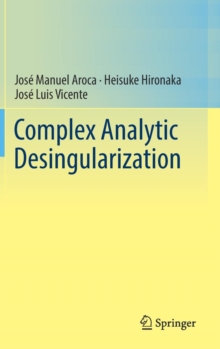
| Title: | Complex Analytic Desingularization |
| Authors: | Author: Heisuke Hironaka, Jose Manuel Aroca, Jose Luis Vicente |
| Page Count: | 330 |
| Subjects: | Algebraic geometry, Algebraic geometry |
| Description: | Select Guide Rating [From the foreword by B. Teissier] The main ideas of the proof of resolution of singularities of complex-analytic spaces presented here were developed by Heisuke Hironaka in the late 1960s and early 1970s. Since then, a number of proofs, all inspired by Hironaka's general approach, have appeared, the validity of some of them extending beyond the complex analytic case. The proof has now been so streamlined that, although it was seen 50 years ago as one of the most difficult proofs produced by mathematics, it can now be the subject of an advanced university course. Yet, far from being of historical interest only, this long-awaited book will be very rewarding for any mathematician interested in singularity theory. Rather than a proof of a canonical or algorithmic resolution of singularities, what is presented is in fact a masterly study of the infinitely near “worst” singular points of a complex analytic space obtained by successive “permissible” blowing ups and of the way to tame them using certain subspaces of the ambient space. This taming proves by an induction on the dimension that there exist finite sequences of permissible blowing ups at the end of which the worst infinitely near points have disappeared, and this is essentially enough to obtain resolution of singularities. Hironaka’s ideas for resolution of singularities appear here in a purified and geometric form, in part because of the need to overcome the globalization problems appearing in complex analytic geometry. In addition, the book contains an elegant presentation of all the prerequisites of complex analytic geometry, including basic definitions and theorems needed to follow the development of ideas and proofs. Its epilogue presents the use of similar ideas in the resolution of singularities of complex analytic foliations. This text will be particularly useful and interesting for readers of the younger generation who wish to understand one of the most fundamental results in algebraic and analytic geometry and invent possible extensions and applications of the methods created to prove it. [From the foreword by B. Teissier] The main ideas of the proof of resolution of singularities of complex-analytic spaces presented here were developed by Heisuke Hironaka in the late 1960s and early 1970s. Since then, a number of proofs, all inspired by Hironaka''s general approach, have appeared, the validity of some of them extending beyond the complex analytic case. The proof has now been so streamlined that, although it was seen 50 years ago as one of the most difficult proofs produced by mathematics, it can now be the subject of an advanced university course. Yet, far from being of historical interest only, this long-awaited book will be very rewarding for any mathematician interested in singularity theory. Rather than a proof of a canonical or algorithmic resolution of singularities, what is presented is in fact a masterly study of the infinitely near "worst" singular points of a complex analytic space obtained by successive "permissible" blowing ups and of the way to tame them using certain subspaces of the ambient space. This taming proves by an induction on the dimension that there exist finite sequences of permissible blowing ups at the end of which the worst infinitely near points have disappeared, and this is essentially enough to obtain resolution of singularities. Hironaka''s ideas for resolution of singularities appear here in a purified and geometric form, in part because of the need to overcome the globalization problems appearing in complex analytic geometry. In addition, the book contains an elegant presentation of all the prerequisites of complex analytic geometry, including basic definitions and theorems needed to follow the development of ideas and proofs. Its epilogue presents the use of similar ideas in the resolution of singularities of complex analytic foliations. This text will be particularly useful and interesting for readers of the younger generation who wish to understand one of the most fundamental results in algebraic and analytic geometry and invent possible extensions and applications of the methods created to prove it. |
| Imprint Name: | Springer Verlag, Japan |
| Publisher Name: | Springer Verlag, Japan |
| Country of Publication: | GB |
| Publishing Date: | 2018-11-14 |