
Description
| Product ID: | 9781531501815 |
| Product Form: | Paperback / softback |
| Country of Manufacture: | GB |
| Title: | Sufi Deleuze |
| Subtitle: | Secretions of Islamic Atheism |
| Authors: | Author: Michael Muhammad Knight |
| Page Count: | 208 |
| Subjects: | Structuralism and Post-structuralism, Deconstructionism, Structuralism, Post-structuralism, Islam, Social groups: religious groups and communities, Islamic theology, Islamic studies |
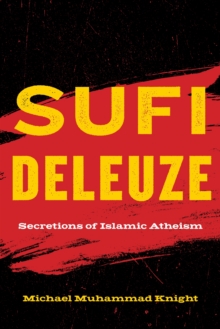
| Description: | Select Guide Rating “There is always an atheism to be extracted from a religion,” Deleuze and Guattari write in their final collaboration, What Is Philosophy? Their claim that Christianity “secretes” atheism “more than any other religion,” however, reflects the limits of their archive. Theological projects seeking to engage Deleuze remain embedded within Christian theologies and intellectual histories; whether they embrace, resist, or negotiate with Deleuze’s atheism, the atheism in question remains one extracted from Christian theology, a Christian atheism. In Sufi Deleuze, Michael Muhammad Knight offers an intervention, engaging Deleuzian questions and themes from within Islamic tradition. Even if Deleuze did not think of himself as a theologian, Knight argues, to place Deleuze in conversation with Islam is a project of comparative theology and faces the challenge of any comparative theology: It seemingly demands that complex, internally diverse traditions can speak as coherent, monolithic wholes. To start from such a place would not only defy Islam’s historical multiplicity but also betray Deleuze’s model of the assemblage, which requires attention to not only the organizing and stabilizing tendencies within a structure but also the points at which a structure resists organization, its internal heterogeneity, and unpredictable “lines of flight.”A Deleuzian approach to Islamic theology would first have to affirm that there is no such thing as a universal “Islamic theology” that can speak for all Muslims in all historical settings, but rather a multiplicity of power struggles between major and minor forces that contest each other over authenticity, authority, and the making of “orthodoxy.” The discussions in Sufi Deleuze thus highlight Islam’s extraordinary range of possibilities, not only making use of canonically privileged materials such as the Qur’an and major hadith collections, but also exploring a variety of marginalized resources found throughout Islam that challenge the notion of a singular “mainstream” interpretive tradition. To say it in Deleuze’s vocabulary, Islam is a rhizome. “There is always an atheism to be extracted from a religion,” Deleuze and Guattari write in their final collaboration, What Is Philosophy? Their claim that Christianity “secretes” atheism “more than any other religion,” however, reflects the limits of their archive. Theological projects seeking to engage Deleuze remain embedded within Christian theologies and intellectual histories; whether they embrace, resist, or negotiate with Deleuze’s atheism, the atheism in question remains one extracted from Christian theology, a Christian atheism. In Sufi Deleuze, Michael Muhammad Knight offers an intervention, engaging Deleuzian questions and themes from within Islamic tradition. |
| Imprint Name: | Fordham University Press |
| Publisher Name: | Fordham University Press |
| Country of Publication: | GB |
| Publishing Date: | 2023-02-07 |