
Description
| Product ID: | 9781487598563 |
| Product Form: | Paperback / softback |
| Country of Manufacture: | GB |
| Series: | Heritage |
| Title: | The Valley of Vision |
| Subtitle: | Blake as Prophet and Revolutionary |
| Authors: | Author: Peter Fisher, Northrop Frye |
| Page Count: | 278 |
| Subjects: | Literature: history and criticism, Literature: history & criticism, Literary studies: general, Literary studies: c 1800 to c 1900, Literary studies: c 1500 to c 1800, Literary studies: c 1800 to c 1900 , United Kingdom, Great Britain, Ireland, c 1700 to c 1800 |
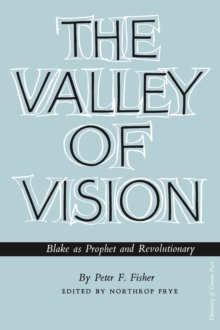
| Description: | The book is not a study of Blake's sources but of his context. The author is trying to answer the question: given Blake's general point of view, why does he make the specific judgments he does make, judgments which so often seem merely glib or petulant or perverse. The author of this important contribution to the study of Blake was tragically drowned in a sailing accident when he had almost completed it in manuscript. His was a critical mind of singular erudition and power. As is abundantly evidenced in these chapters which Northrop Frye has prepared for publication. Fisher had made a careful study of Oriental philosophy and of Plato and the Neo-Platonists and this background enabled him to make an original and fruitful analysis of his central interest, Blake. The book is not a study of Blake''s sources but of his context. The author is trying to answer the question: given Blake''s general point of view, why does he make the specific judgments he does make, judgments which so often seem merely glib or petulant or perverse. Blake himself, in explaining a painting, remarked: "It ought to be understood that the Persons, Moses and Abraham, are not here meant, but the States Signified by those Names." Fisher explains what Blake meant by "states," and shows that such names as Plato, Bacon or Newton, or such terms as "priest" or "deist" in Blake''s writings, refer not to individuals but to cultural forces in Western civilization, the influence of which accounted for the social conditions that Blake attacked. The attack itself, Fisher shows, was based on a revolutionary dialectic, a sense of the underlying opposition between reactionaries committed to obscurantism and social injustice, the "Elect" as Blake calls them, and the prophets committed to a greater vision (the "Reprobate"), with the mass of the public (the "Redeemed") in between. |
| Imprint Name: | University of Toronto Press |
| Publisher Name: | University of Toronto Press |
| Country of Publication: | GB |
| Publishing Date: | 1961-12-15 |