
Description
| Product ID: | 9781108499552 |
| Product Form: | Hardback |
| Country of Manufacture: | GB |
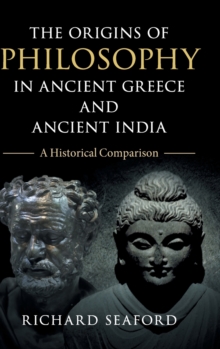
| Title: | The Origins of Philosophy in Ancient Greece and Ancient India |
| Subtitle: | A Historical Comparison |
| Authors: | Author: Richard Seaford |
| Page Count: | 382 |
| Subjects: | Ancient history, Ancient history: to c 500 CE, Philosophy, Ancient Greek and Roman philosophy, East Asian and Indian philosophy, History of ideas, Philosophy, Western philosophy: Ancient, to c 500, Oriental & Indian philosophy, History of ideas |
| Description: | Select Guide Rating Locates the origins and early form of Indian and Greek philosophy, and the striking similarities between them, in their entire societal and religious context. The cities of Greece and northern India were distinctive by virtue of being pervasively monetised, which was a central factor in their metaphysical transformation. Why did Greek philosophy begin in the sixth century BCE? Why did Indian philosophy begin at about the same time? Why did the earliest philosophy take the form that it did? Why was this form so similar in Greece and India? And how do we explain the differences between them? These questions can only be answered by locating the philosophical intellect within its entire societal context, ignoring neither ritual nor economy. The cities of Greece and northern India were in this period distinctive also by virtue of being pervasively monetised. The metaphysics of both cultures is marked by the projection (onto the cosmos) and the introjection (into the inner self) of the abstract, all-pervasive, quasi-omnipotent, impersonal substance embodied in money (especially coinage). And in both cultures this development accompanied the interiorisation of the cosmic rite of passage (in India sacrifice, in Greece mystic initiation). |
| Imprint Name: | Cambridge University Press |
| Publisher Name: | Cambridge University Press |
| Country of Publication: | GB |
| Publishing Date: | 2019-12-05 |