
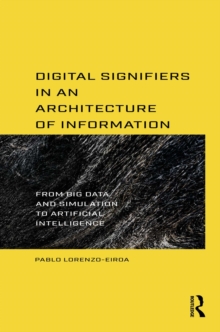
Description
| Product ID: | 9781032272689 |
| Product Form: | Paperback / softback |
| Country of Manufacture: | GB |
| Title: | Digital Signifiers in an Architecture of Information |
| Subtitle: | From Big Data and Simulation to Artificial Intelligence |
| Authors: | Author: Pablo Lorenzo-Eiroa |
| Page Count: | 472 |
| Subjects: | Theory of architecture, Theory of architecture, Architecture: professional practice, City and town planning: architectural aspects, History of architecture, Regional and area planning, Information technology: general topics, Artificial intelligence, Architecture: professional practice, City & town planning - architectural aspects, History of architecture, Regional & area planning, Information technology: general issues, Artificial intelligence |
| Description: | Select Guide Rating This book proposes a new critical relationship between computation and architecture, developing a history and theory of representation in architecture to understand and unleash potential means to open up creativity in the field. This book proposes a new critical relationship between computation and architecture, developing a history and theory of representation in architecture to understand and unleash potential means to open up creativity in the field. Historically, architecture has led to spatial representation. Today, computation has established new representational paradigms that can be compared to spatial representations, such as the revolution of perspective in the Renaissance. Architects now use software, robotics, and fabrication tools with very little understanding and participation in how these tools influence, revolutionize, and determine both architecture and its construction today. Why does the discipline of architecture not have a higher degree of authorship in the conception and development of computational technologies that define spatial representation? This book critically explores the relationship between history, theory, and cultural criticism. Lorenzo-Eiroa positions new understandings through parallel historical sections and theories of many revolutionary representational architecture canons displaced by conventional spatial projection. He identifies the architects, artists, mathematicians, and philosophers that were able to revolutionize their disciplines through the development of new technologies, new systems of representation, and new lenses to understand reality. This book frames the discussion by addressing new means to understand and expand architecture authorship in relation to the survey, information, representation, higher dimensional space, Big Data, and Artificial Intelligence – in the pursuit of activating an architecture of information. This will be important reading for upper-level students and researchers of architecture and architectural theory, especially those with a keen interest in computational design and robotic fabrication. |
| Imprint Name: | Routledge |
| Publisher Name: | Taylor & Francis Ltd |
| Country of Publication: | GB |
| Publishing Date: | 2023-05-31 |