
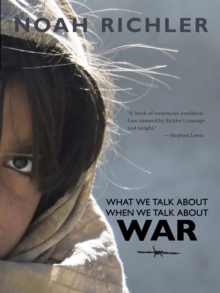
Description
| Product ID: | 9780864926227 |
| Product Form: | Paperback / softback |
| Country of Manufacture: | CA |
| Title: | What We Talk About When We Talk About War |
| Authors: | Author: Noah Richler |
| Page Count: | 376 |
| Subjects: | Central / national / federal government policies, Central government policies, Civics and citizenship, Warfare and defence, Civil rights & citizenship, Warfare & defence |
| Description: | An Amazon.ca Editor's Pick for 2012 and a Globe and Mail Top 100 Book of 2012Shortlisted, Governor General's Award for Non-Fiction, Shaughnessy Cohen Prize for Political Writing, and John W. Dafoe Book PrizeLonglisted, Charles Taylor Prize for Literary Non-FictionA provocative examination of how communications has shaped the language of the media, and vice versa, and how rhetoric shapes how Canadians thinks of themselves as a nation and Canada's engagement in peacekeeping, war, and on the international stage. According to Richler, each phase of engagement in Afghanistan has been shaped not only by rhetoric but an overarching narrative structure. This topic is very much in discussion at the moment. With the withdrawal of Canadian troops (at least in part) from Afghanistan, it becomes clear there had been a rhetorical cycle. Where once Canada wielded the myth of itself as a peacekeeping nation, the past decade has seen a marked shift away from this, emphasizing the Canadian soldier as warrior. Yet now, as the country withdraws, the oratorical language we use steps away from heroes, able warriors, and sacrifice and back towards a more comfortable vision of Canada in a peacekeeping/training role. In recent years, Canada has made large financial investments in the apparatus of war — in a manner it hasn't in a very long time — and as the realities of war are brought home (the losses, the tragedies, the atrocities, the lasting repercussions that come home with the soldiers who were on the front lines), Richler contends that it's crucial we understand our national perspective on war — how we have framed it, how we continue to frame it. Using recent events to bolster his arguments, including the shooting of American congresswoman Gabrielle Giffords and the earthquake in Haiti, Richler argues that very possibly the epic narrative of Canada is winding back down to that of the novel as we slowly regain our peacekeeping agenda. An Amazon.ca Editor''s Pick for 2012 and a Globe and Mail Top 100 Book of 2012 A provocative examination of how communications has shaped the language of the media, and vice versa, and how rhetoric shapes how Canadians thinks of themselves as a nation and Canada's engagement in peacekeeping, war, and on the international stage. According to Richler, each phase of engagement in Afghanistan has been shaped not only by rhetoric but an overarching narrative structure. This topic is very much in discussion at the moment. With the withdrawal of Canadian troops (at least in part) from Afghanistan, it becomes clear there had been a rhetorical cycle. Where once Canada wielded the myth of itself as a peacekeeping nation, the past decade has seen a marked shift away from this, emphasizing the Canadian soldier as warrior. Yet now, as the country withdraws, the oratorical language we use steps away from heroes, able warriors, and sacrifice and back towards a more comfortable vision of Canada in a peacekeeping/training role. In recent years, Canada has made large financial investments in the apparatus of war — in a manner it hasn't in a very long time — and as the realities of war are brought home (the losses, the tragedies, the atrocities, the lasting repercussions that come home with the soldiers who were on the front lines), Richler contends that it's crucial we understand our national perspective on war — how we have framed it, how we continue to frame it. Using recent events to bolster his arguments, including the shooting of American congresswoman Gabrielle Giffords and the earthquake in Haiti, Richler argues that very possibly the epic narrative of Canada is winding back down to that of the novel as we slowly regain our peacekeeping agenda. |
| Imprint Name: | Goose Lane Editions |
| Publisher Name: | Goose Lane Editions |
| Country of Publication: | GB |
| Publishing Date: | 2012-04-20 |