
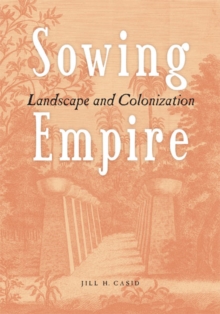
Description
| Product ID: | 9780816640966 |
| Product Form: | Paperback / softback |
| Country of Manufacture: | US |
| Title: | Sowing Empire |
| Subtitle: | Landscape And Colonization |
| Authors: | Author: Jill H. Casid |
| Page Count: | 312 |
| Subjects: | Landscape architecture and design, Landscape art & architecture, History, History |
| Description: | Planting and transplanting, seeding and reshaping—landscaping practices that emerged in the eighteenth century—are inextricable from the contested terrain of empire within which they operated. From the plantations of the “nabobs” to the island gardens of narrative fiction, from William Beckford’s estate at Fonthill to Marie Antoinette’s ornamented farm, Sowing Empire considers imperial relandscaping—its patriarchal organization, heterosexual reproduction, and slavery—and how it contributed to the construction of imperial power. At the same time, the book shows how these picturesque landscapes and sugar plantations contained within them the seeds of resistance—how, for instance, slave gardens and the Afro-Caribbean practice of Vodou threatened authority and created new possibilities for once again transforming the landscape.In an ambitious work of wide-ranging literary, visual, and historical allusion, Jill H. Casid examines how landscaping functioned in an imperial mode that defined and remade the “heartlands” of nations as well as the contact zones and colonial peripheries in the West and East Indies. Revealing the colonial landscape as far more than an agricultural system—as a means of regulating national, sexual, and gender identities—Casid also traces how the circulation of plants and hybridity influenced agriculture and landscaping on European soil and how colonial contacts materially shaped what we take as “European.”Utilizing a wide range of both visual and written sources—maps, literature, and travel writing—this book is interdisciplinary in its methodology and in its scope. Sowing Empire explores how postcolonial and queer studies can alter art history and visual studies and, in turn, what close attention to the visual may offer to both postcolonial theorizing and historically and materially based colonial cultural studies.Jill H. Casid is assistant professor of art history and part of the developing transdisciplinary program in visual culture studies at the University of Wisconsin, Madison. Planting and transplanting, seeding and reshaping—landscaping practices that emerged in the eighteenth century—are inextricable from the contested terrain of empire within which they operated. From the plantations of the “nabobs” to the island gardens of narrative fiction, from William Beckford’s estate at Fonthill to Marie Antoinette’s ornamented farm, Sowing Empire considers imperial relandscaping—its patriarchal organization, heterosexual reproduction, and slavery—and how it contributed to the construction of imperial power. At the same time, the book shows how these picturesque landscapes and sugar plantations contained within them the seeds of resistance—how, for instance, slave gardens and the Afro-Caribbean practice of Vodou threatened authority and created new possibilities for once again transforming the landscape.In an ambitious work of wide-ranging literary, visual, and historical allusion, Jill H. Casid examines how landscaping functioned in an imperial mode that defined and remade the “heartlands” of nations as well as the contact zones and colonial peripheries in the West and East Indies. Revealing the colonial landscape as far more than an agricultural system—as a means of regulating national, sexual, and gender identities—Casid also traces how the circulation of plants and hybridity influenced agriculture and landscaping on European soil and how colonial contacts materially shaped what we take as “European.”Utilizing a wide range of both visual and written sources—maps, literature, and travel writing—this book is interdisciplinary in its methodology and in its scope. Sowing Empire explores how postcolonial and queer studies can alter art history and visual studies and, in turn, what close attention to the visual may offer to both postcolonial theorizing and historically and materially based colonial cultural studies.Jill H. Casid is assistant professor of art history and part of the developing transdisciplinary program in visual culture studies at the University of Wisconsin, Madison. |
| Imprint Name: | University of Minnesota Press |
| Publisher Name: | University of Minnesota Press |
| Country of Publication: | GB |
| Publishing Date: | 2004-12-15 |