
Description
| Product ID: | 9780268202200 |
| Product Form: | Paperback / softback |
| Country of Manufacture: | GB |
| Title: | Translating Christ in the Middle Ages |
| Subtitle: | Gender, Authorship, and the Visionary Text |
| Authors: | Author: Barbara Zimbalist |
| Page Count: | 330 |
| Subjects: | History of art, History of art: Byzantine & Medieval art c 500 CE to c 1400, Literary studies: ancient, classical and medieval, History, Christianity, Gender studies: women and girls, Literary studies: classical, early & medieval, Medieval history, Christian mysticism, Gender studies: women, Europe |
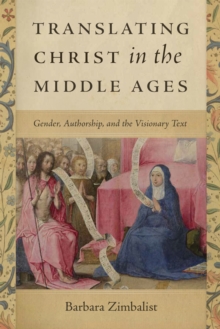
| Description: | Select Guide Rating This study reveals how women’s visionary texts played a central role within medieval discourses of authorship, reading, and devotion. From the twelfth to the fifteenth centuries, women across northern Europe began committing their visionary conversations with Christ to the written word. Translating Christ in this way required multiple transformations: divine speech into human language, aural event into textual artifact, visionary experience into linguistic record, and individual encounter into communal repetition. This ambitious study shows how women’s visionary texts form an underexamined literary tradition within medieval religious culture. Barbara Zimbalist demonstrates how, within this tradition, female visionaries developed new forms of authorship, reading, and devotion. Through these transformations, the female visionary authorized herself and her text, and performed a rhetorical imitatio Christi that offered models of interpretive practice and spoken devotion to her readers. This literary-historical tradition has not yet been fully recognized on its own terms. By exploring its development in hagiography, visionary texts, and devotional literature, Zimbalist shows how this literary mode came to be not only possible but widespread and influential. She argues that women’s visionary translation reconfigured traditional hierarchies and positions of spiritual power for female authors and readers in ways that reverberated throughout late-medieval literary and religious cultures. In translating their visionary conversations with Christ into vernacular text, medieval women turned themselves into authors and devotional guides, and formed their readers into textual communities shaped by gendered visionary experiences and spoken imitatio Christi. Comparing texts in Latin, Dutch, French, and English, Translating Christ in the Middle Ages explores how women’s visionary translation of Christ’s speech initiated larger transformations of gendered authorship and religious authority within medieval culture. The book will interest scholars in different linguistic and religious traditions in medieval studies, history, religious studies, and women’s and gender studies. This study reveals how women’s visionary texts played a central role within medieval discourses of authorship, reading, and devotion. From the twelfth to the fifteenth centuries, women across northern Europe began committing their visionary conversations with Christ to the written word. Translating Christ in this way required multiple transformations: divine speech into human language, aural event into textual artifact, visionary experience into linguistic record, and individual encounter into communal repetition. This ambitious study shows how women’s visionary texts form an underexamined literary tradition within medieval religious culture. Barbara Zimbalist demonstrates how, within this tradition, female visionaries developed new forms of authorship, reading, and devotion. Through these transformations, the female visionary authorized herself and her text, and performed a rhetorical imitatio Christi that offered models of interpretive practice and spoken devotion to her readers. This literary-historical tradition has not yet been fully recognized on its own terms. By exploring its development in hagiography, visionary texts, and devotional literature, Zimbalist shows how this literary mode came to be not only possible but widespread and influential. She argues that women’s visionary translation reconfigured traditional hierarchies and positions of spiritual power for female authors and readers in ways that reverberated throughout late-medieval literary and religious cultures. In translating their visionary conversations with Christ into vernacular text, medieval women turned themselves into authors and devotional guides, and formed their readers into textual communities shaped by gendered visionary experiences and spoken imitatio Christi. Comparing texts in Latin, Dutch, French, and English, Translating Christ in the Middle Ages explores how women’s visionary translation of Christ’s speech initiated larger transformations of gendered authorship and religious authority within medieval culture. The book will interest scholars in different linguistic and religious traditions in medieval studies, history, religious studies, and women’s and gender studies. |
| Imprint Name: | University of Notre Dame Press |
| Publisher Name: | University of Notre Dame Press |
| Country of Publication: | GB |
| Publishing Date: | 2022-02-15 |