
Description
| Product ID: | 9780192855183 |
| Product Form: | Hardback |
| Country of Manufacture: | GB |
| Series: | Oxford Studies in African Politics and International Relations |
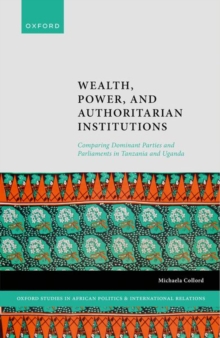
| Title: | Wealth, Power, and Authoritarian Institutions |
| Subtitle: | Comparing Dominant Parties and Parliaments in Tanzania and Uganda |
| Authors: | Author: Michaela Collord |
| Page Count: | 320 |
| Subjects: | Comparative politics, Comparative politics, Political structures: democracy, Political structures: totalitarianism and dictatorship, Political structures: democracy, Political structures: totalitarianism & dictatorship |
| Description: | Through an analysis of the recent political history of Tanzania and Uganda, Wealth, Power, and Authoritarian Institutions offers a novel explanation of why authoritarian parties and legislatures vary in strength, and why this variation matters. Through an analysis of the recent political history of Tanzania and Uganda, Wealth, Power, and Authoritarian Institutions offers a novel explanation of why authoritarian parties and legislatures vary in strength, and why this variation matters. Michaela Collord elaborates a view of authoritarian political institutions as both reflecting and magnifying elite power dynamics. While there are many sources of elite power, the book centres on material power. It outlines how diverse trajectories of state-led capitalist development engender differing patterns of wealth accumulation and elite contestation across regimes. These differences, in turn, influence institutional landscapes. Where accumulation is more closely controlled by state and party leaders, as was true in Tanzania until economic liberalization in the 1980s, rival factions remain subdued. Ruling parties can then consolidate relatively strong institutional structures, and parliament remains marginal. Conversely, where a class of private wealth accumulators expands, as occurred in Tanzania after the 1980s and in Uganda after the National Resistance Movement took power in 1986, rival factions can more easily form, simultaneously eroding party institutions and encouraging greater legislative strength. Collord uses this analysis to reassess the significance of a stronger legislature. She considers its influence on distributive politics, both regressive and progressive. She also considers its relation to democratization, particularly in a context of broader liberalizing reforms. The book ultimately encourages a closer examination of how would-be democratic institutions interact with an underlying power distribution, shaping in whose interests they operate. Oxford Studies in African Politics and International Relations is a series for scholars and students working on African politics and International Relations and related disciplines. Volumes concentrate on contemporary developments in African political science, political economy, and International Relations, such as electoral politics, democratization, decentralization, gender and political representation, the political impact of natural resources, the dynamics and consequences of conflict, comparative political thought, and the nature of the continent''s engagement with the East and West. Comparative and mixed methods work is particularly encouraged. Case studies are welcomed but should demonstrate the broader theoretical and empirical implications of the study and its wider relevance to contemporary debates. The focus of the series is on sub-Saharan Africa, although proposals that explain how the region engages with North Africa and other parts of the world are of interest. General Editors Nic Cheeseman, Peace Medie, and Ricardo Soares de Oliveira. |
| Imprint Name: | Oxford University Press |
| Publisher Name: | Oxford University Press |
| Country of Publication: | GB |
| Publishing Date: | 2024-05-20 |