
Description
| Product ID: | 9780192807359 |
| Product Form: | Paperback / softback |
| Country of Manufacture: | GB |
| Series: | Oxford World's Classics |
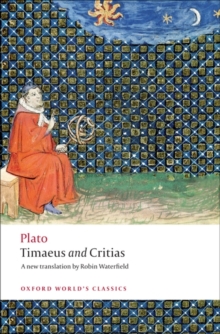
| Title: | Timaeus and Critias |
| Authors: | Author: Plato, Robin Waterfield |
| Page Count: | 240 |
| Subjects: | Ancient Greek and Roman philosophy, Western philosophy: Ancient, to c 500, Philosophy: metaphysics and ontology, Philosophy of science, Philosophy: metaphysics & ontology, Philosophy of science, Ancient Greece |
| Description: | Select Guide Rating In Timaeus Plato attempts to describe and explain the structure of the universe: the creator god, the elements, the lower gods, the stars, and men. The companion piece, Critias, is the origin of the story of Atlantis, the lost empire defeated by ancient Athenians. This is the clearest translation yet of these crucial ancient texts. ''The god wanted everything to be good, marred by as little imperfection as possible.''Timaeus, one of Plato''s acknowledged masterpieces, is an attempt to construct the universe and explain its contents by means of as few axioms as possible. The result is a brilliant, bizarre, and surreal cosmos - the product of the rational thinking of a creator god and his astral assistants, and of purely mechanistic causes based on the behaviour of the four elements. At times dazzlingly clear, at times intriguingly opaque, this was state-of-the-art science in the middle of the fourth century BC. The world is presented as a battlefield of forces that are unified only by the will of God, who had to do the best he could with recalcitrant building materials.The unfinished companion piece, Critias, is the foundational text for the story of Atlantis. It tells how a model society became corrupt, and how a lost race of Athenians defeated the aggression of the invading Atlanteans. This new edition combines the clearest translation yet of these crucial ancient texts with an illuminating introduction and diagrams. ABOUT THE SERIES: For over 100 years Oxford World''s Classics has made available the widest range of literature from around the globe. Each affordable volume reflects Oxford''s commitment to scholarship, providing the most accurate text plus a wealth of other valuable features, including expert introductions by leading authorities, helpful notes to clarify the text, up-to-date bibliographies for further study, and much more. |
| Imprint Name: | Oxford University Press |
| Publisher Name: | Oxford University Press |
| Country of Publication: | GB |
| Publishing Date: | 2008-11-13 |