
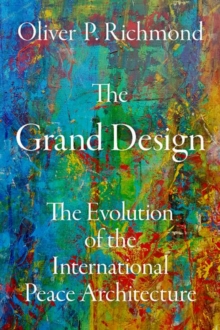
Description
| Product ID: | 9780190850449 |
| Product Form: | Hardback |
| Country of Manufacture: | US |
| Title: | The Grand Design |
| Subtitle: | The Evolution of the International Peace Architecture |
| Authors: | Author: Oliver P. Richmond |
| Page Count: | 320 |
| Subjects: | Peace studies and conflict resolution, Peace studies & conflict resolution, Political structures: democracy, International relations, Legal history, Political structures: democracy, International relations, Legal history |
| Description: | This book examines the development of the "grand design" and various subsequent attempts to develop a peaceful international order, and its implications for the current international peace architecture. Oliver P. Richmond argues that post-WWII liberal peace, which has aimed to balance liberty with regulation through law, democracy, human rights, and free trade, has recently given way to a retrogressive, technologically driven neoliberal peace, which is more oriented towards free trade, counter-terrorism and insurgency, surveillance, and state security. The Grand Design provides a sweeping look at the troubled history of peacebuilding in order to consider what the next-stage, "post-liberal peace," might look like. The guiding principle of peacemaking and peacebuilding over the past quarter century has been "liberal peace": the promotion of democracy, capitalism, law, and respect for human rights. These components represent a historic effort to prevent a reoccurrence of the nationalism, fascism, and economic collapse that led to the World Wars as well as many later conflicts. Ultimately, this strategy has been somewhat successful in reducing war between countries, but it has failed to produce legitimate and sustainable forms of peace at the domestic level. The goals of peacebuilding have changed over time and place, but they have always been built around compromise via processes of intervention aimed at supporting "progress" in conflict-affected countries. They have simultaneously promoted changes in the regional and global order. As Oliver P. Richmond argues in this book, the concept of peace has evolved continuously through several eras: from the imperial era, through the states-system, liberal, and current neoliberal eras of states and markets. It holds the prospect of developing further through the emerging "digital" era of transnational networks, new technologies, and heightened mobility. Yet, as recent studies have shown, only a minority of modern peace agreements survive for more than a few years and many peace agreements and peacebuilding missions have become intractable, blocked, or frozen. This casts a shadow on the legitimacy, stability, and effectiveness of the overall international peace architecture, reflecting significant problems in the evolution of an often violently contested international and domestic order.This book examines the development of the international peace architecture, a "grand design" comprising various subsequent attempts to develop a peaceful international order. Richmond examines six main theoretical-historical stages in this process often addressed through peacekeeping and international mediation, including the balance of power mechanism of the 19th Century, liberal internationalism after World War I, and the expansion of rights and decolonization after World War II. It also includes liberal peacebuilding after the end of the Cold War, neoliberal statebuilding during the 2000s, and an as yet unresolved current "digital" stage. They have produced a substantial, though fragile, international peace architecture. However, it is always entangled with, and hindered by, blockages and a more substantial counter-peace framework. The Grand Design provides a sweeping look at the troubled history of peace processes, peacemaking, peacekeeping, and peacebuilding, and their effects on the evolution of international order. It also considers what the next stage may bring. |
| Imprint Name: | Oxford University Press Inc |
| Publisher Name: | Oxford University Press Inc |
| Country of Publication: | GB |
| Publishing Date: | 2022-07-12 |