
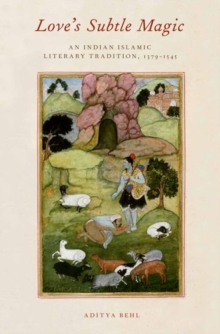
Description
| Product ID: | 9780190628802 |
| Product Form: | Paperback / softback |
| Country of Manufacture: | GB |
| Title: | Love's Subtle Magic |
| Subtitle: | An Indian Islamic Literary Tradition, 1379-1545 |
| Authors: | Author: Aditya , formerly Associate Professor of South Asian Studies (deceased), University of Pennsylvania, Wendy Doniger |
| Page Count: | 418 |
| Subjects: | Literary studies: ancient, classical and medieval, Literary studies: classical, early & medieval, Asian history, History, Islamic groups: Sufis, Asian history, Early history: c 500 to c 1450/1500, Sufism & Islamic mysticism, India, c 1000 CE to c 1500 |
| Description: | The encounter between Muslim and Hindu remains one of the defining issues of South Asian society today. This encounter began as early as the 8th century, and the first Muslim kingdom in India would be established at the end of the 12th century. This powerful kingdom, the Sultanate of Delhi, eventually reduced to vassalage almost every independent kingdom on the subcontinent. In Love''s Subtle Magic, a remarkable and deeply original book, Aditya Behl uses a little-understood genre of Sufi literature to paint an entirely new picture of the evolution of Indian culture during the period of Muslim domination. The encounter between Muslim and Hindu remains one of the defining issues of South Asian society today. It began as early as the 8th century, and the first Muslim kingdom in India, the Sultanate of Delhi, was established at the end of the 12th century. This power eventually reduced to vassalage almost every independent kingdom on the subcontinent. In Love''s Subtle Magic, a remarkable and highly original book, Aditya Behl uses a little-understood genre of Sufi literature to paint an entirely new picture of the evolution of Indian culture during the earliest period of Muslim domination. These curious romantic tales transmit a profound religious message through the medium of adventurous stories of love. Although composed in the Muslim courts, they are written in a vernacular Indian language and involve Hindu yogis, Hindu princes and princesses, and Hindu gods. Until now, they have defied analysis. Behl shows that the Sufi authors of these charming tales sought to convey an Islamic vision via an Indian idiom. They thus constitute the earliest attempt at the indigenization of Islamic literature in an Indian setting. More important, however, Behl''s analysis brilliantly illuminates the cosmopolitan and composite culture of the Sultanate India in which they were composed. This in turn compels us completely to rethink the standard of the opposition between Indian Hindu and foreign Muslim and recognize that the Indo-Islamic culture of this era was already significantly Indian in many important ways. |
| Imprint Name: | Oxford University Press Inc |
| Publisher Name: | Oxford University Press Inc |
| Country of Publication: | GB |
| Publishing Date: | 2016-09-08 |