
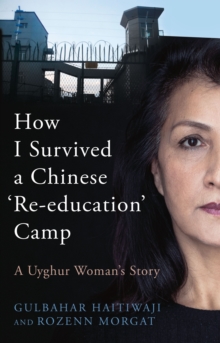
Description
| Product ID: | 9781912454907 |
| Product Form: | Hardback |
| Country of Manufacture: | GB |
| Title: | How I Survived A Chinese 'Re-education' Camp |
| Subtitle: | A Uyghur Woman's Story |
| Authors: | Author: Gulbahar Haitiwaji, Edward Gauvin, Rozenn Morgat |
| Page Count: | 256 |
| Subjects: | Memoirs, Memoirs, Human rights, civil rights, Human rights, civil rights, Political oppression and persecution, Human rights, Religious freedom / freedom of worship, Political oppression & persecution |
| Description: | Select Guide Rating Gulbahar Haitiwaji is the first Uyghur woman survivor China's re-education prison camps to give a personal account of the reality of life inside their walls. This rare trip into China’s barbarous gulag is visceral and internationally important. ''An indispensable account'' – Sunday Times ''Moving and devastating'' – The Literary Review ''An intimate, highly sensory self-portrait'' – Sunday Telegraph (Five Stars) FIRST MEMOIR ABOUT CHINA''A ‘RE-EDUCATION’ CAMPS BY A UYGHUR WOMAN Since 2017, one million Uyghurs have been seized by the Chinese authorities and sent to ‘re-education’ camps, in what the US Government and human rights groups describe as a genocide. Few have made it out to the West. One is Gulbahar Haitiwaji. For three years, she endured hundreds of hours of interrogations, freezing cold, forced sterilisation, and a programme of de-personalisation meant to destroy her free will and her memories. This intimate account reveals the long-suppressed truth about China’s gulag. It tells the story of a woman confronted by an all-powerful state bent on crushing her spirit – and her battle for freedom and dignity. Extract ‘In the camps, the ‘re-education’ process applies the same remorseless method to destroying all its victims. It starts out by stripping you of your individuality. It takes away your name, your clothes, your hair. There is nothing now to distinguish you from anyone else. ''Then the process takes over your body by subjecting it to a hellish routine: being forced to repeatedly recite the glories of the Communist Party for eleven hours a day in a windowless classroom. Falter, and you are punished. So you keep on saying the same things over and over again until you can’t feel, can’t think anymore. You lose all sense of time. First the hours, then the days.’ - Gulbahar Haitiwaji Reviews ''Gulbahar''s memoir is an indispensable account, which makes vivid the stench of fearful sweat in the cells, the newly built prison''s permanent reek of white pain. It closely corresponds with other witness statements, giving every indication of being very reliable. Most impressive is her psychological honesty.'' – John Phipps, Sunday Times ''Huge efforts have been made to obfuscate the realities of life in the camps (even speaking openly in Xinjiang about them can lead to incarceration). Although their existence has been well documented abroad and grudgingly admitted by the Chinese state, relatively few first-hand accounts of what actually goes on inside them have emerged. One is Gulbahar Haitiwaji''s moving and devastating How I Survived a Chinese ''Re-education'' Camp.'' – Roderic Wye, Literary Review ''There follows an intimate, highly sensory self-portrait, created with the help of Rozenn Morgat (a journalist with Le Figaro), of an educated woman passing through a system that appears at turns cruel, paranoid, capricious and devastatingly effective. It begins with the confiscation of Haitiwaji''s passport and a police interrogation during which she is shown a photograph of her daughter attending a Uyghur demonstration in Paris. One of the interrogators starts bawling at her - "Your daughter''s a terrorist!" and before long Haitiwaji is plunged into a bewildering world of shackles, bunks and beaten-earth floors; grey gruel and stale bread served up by deaf-mute cooks selected for their silence; the sounds and smells of the communal toilet-bucket; and the buzz of security camera motors as they scan the cell.'' ***** – Christopher Harding, Sunday Telegraph Translated from the French book Rescapée du goulag chinois (Équateurs), How I Survived a Chinese Reeducation Camp is a riveting insight into an authoritarian world. A true story, it reads like a 21st Century version of George Orwell''s 1984 set in modern China. Extract In the camp, I wasn’t Gulbahar, but Number 9. I was forbidden from speaking Uighur, or from praying. There was something extra about the taste of the vile slop that filled our bowls. Were they drugging our meals to make us lose our memories? Physically and mentally, I became a ghost. My weight plummeted. The blinding light worsened my vision, and beneath my eyes, heavy rings made two pockets of shadow. My heart beat so weakly that I could no longer feel it when I pressed my palm to my chest. Whenever I was deemed to have broken the rules, I was slapped or, on one occasion, shackled to a bed for a fortnight. I underwent hundreds of hours of nightmarish interrogations, until chaos gradually took over my soul. Every week, women were taken away and we never saw them again. At night, we’d wake to terrifying screams, as if someone was being tortured upstairs. We listened in silence, absolutely still, to howls that pierced the night. They were the cries of women going mad, begging guards not to hurt them any more. Death lurked in every corner. When the footfalls of guards woke us in the night, I thought our time had come to be executed. When a hand viciously pushed hair-clippers across my skull, I shut my eyes, thinking I was being readied for the scaffold, the electric chair, or drowning. For two years, my husband, Kerim, and two daughters, Gulhumar and Gulnigar, had no idea where I was. They imagined the worst. They believed me dead. I was born into a Uighur family that had lived in Xinjiang for generations. This jewel, more than six times the size of the UK, is at the far western end of China. Its riches include gold, diamonds, natural gas, uranium, and – above all – oil. Since being annexed by the China, we Uighurs have been the stone in the Beijing regime’s shoe. Xinjiang is far too rich a strategic corridor for it to lose and President Xi Jinping wants it cleansed of separatist populations. In short, China wants a Xinjiang without Uighurs. Buy the book to carry on reading |
| Imprint Name: | Canbury Press |
| Publisher Name: | Canbury Press |
| Country of Publication: | GB |
| Publishing Date: | 2022-02-03 |