
Description
| Product ID: | 9780268102548 |
| Product Form: | Paperback / softback |
| Country of Manufacture: | US |
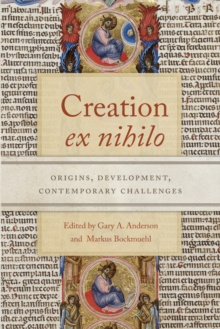
| Title: | Creation ex nihilo |
| Subtitle: | Origins, Development, Contemporary Challenges |
| Authors: | Author: Gary A. Anderson, Markus Bockmuehl |
| Page Count: | 430 |
| Subjects: | Religion and science, Religion & science, History of religion, Christianity, Bibles, History of religion, Christianity, Bibles |
| Description: | The phrase "creation ex nihilo" refers to the primarily Christian notion of God’s creation of everything from nothing. Creation ex nihilo: Origins, Development, Contemporary Challenges presents the findings of a joint research project at Oxford University and the University of Notre Dame in 2014–2015. The doctrine of creation ex nihilo has met with criticism and revisionary theories in recent years from the worlds of science, theology, and philosophy. This volume concentrates on several key areas: the relationship of the doctrine to its purported biblical sources, how the doctrine emerged in the first several centuries of the Common Era, why the doctrine came under heavy criticism in the modern era, how some theologians have responded to the objections, and the relationship of the doctrine to claims of modern science—for example, the fundamental law of physics that matter cannot be created from nothing. Although the Bible never expressly states that God made everything from nothing, various texts are taken to imply that the universe came into existence by divine command and was not assembled from preexisting matter or energy. The contributors to this volume approach this topic from a range of perspectives, from exposition to defense of the doctrine itself. This is a unique and fascinating work whose aim is to present the reader with a compelling set of arguments for why the doctrine should remain central to the grammar of contemporary Christian theology. As such, the book will appeal to theologians as well as those interested in the relationship between theology and science. Contributors: Gary A. Anderson, Markus Bockmuehl, Janet Soskice, Richard J. Clifford, S.J., Sean M. McDonough, Gregory E. Sterling, Khaled Anatolios, John C. Cavadini, Joseph Wawrykow, Tzvi Novick, Daniel Davies, Cyril O’Regan, Ruth Jackson, David Bentley Hart, Adam D. Hincks, S.J., Andrew Pinsent, and Andrew Davison. The phrase "creation ex nihilo" refers to the primarily Christian notion of God’s creation of everything from nothing. Creation ex nihilo: Origins, Development, Contemporary Challenges presents the findings of a joint research project at Oxford University and the University of Notre Dame in 2014–2015. The doctrine of creation ex nihilo has met with criticism and revisionary theories in recent years from the worlds of science, theology, and philosophy. This volume concentrates on several key areas: the relationship of the doctrine to its purported biblical sources, how the doctrine emerged in the first several centuries of the Common Era, why the doctrine came under heavy criticism in the modern era, how some theologians have responded to the objections, and the relationship of the doctrine to claims of modern science—for example, the fundamental law of physics that matter cannot be created from nothing. Although the Bible never expressly states that God made everything from nothing, various texts are taken to imply that the universe came into existence by divine command and was not assembled from preexisting matter or energy. The contributors to this volume approach this topic from a range of perspectives, from exposition to defense of the doctrine itself. This is a unique and fascinating work whose aim is to present the reader with a compelling set of arguments for why the doctrine should remain central to the grammar of contemporary Christian theology. As such, the book will appeal to theologians as well as those interested in the relationship between theology and science. Contributors: Gary A. Anderson, Markus Bockmuehl, Janet Soskice, Richard J. Clifford, S.J., Sean M. McDonough, Gregory E. Sterling, Khaled Anatolios, John C. Cavadini, Joseph Wawrykow, Tzvi Novick, Daniel Davies, Cyril O’Regan, Ruth Jackson, David Bentley Hart, Adam D. Hincks, S.J., Andrew Pinsent, and Andrew Davison. |
| Imprint Name: | University of Notre Dame Press |
| Publisher Name: | University of Notre Dame Press |
| Country of Publication: | GB |
| Publishing Date: | 2021-07-15 |